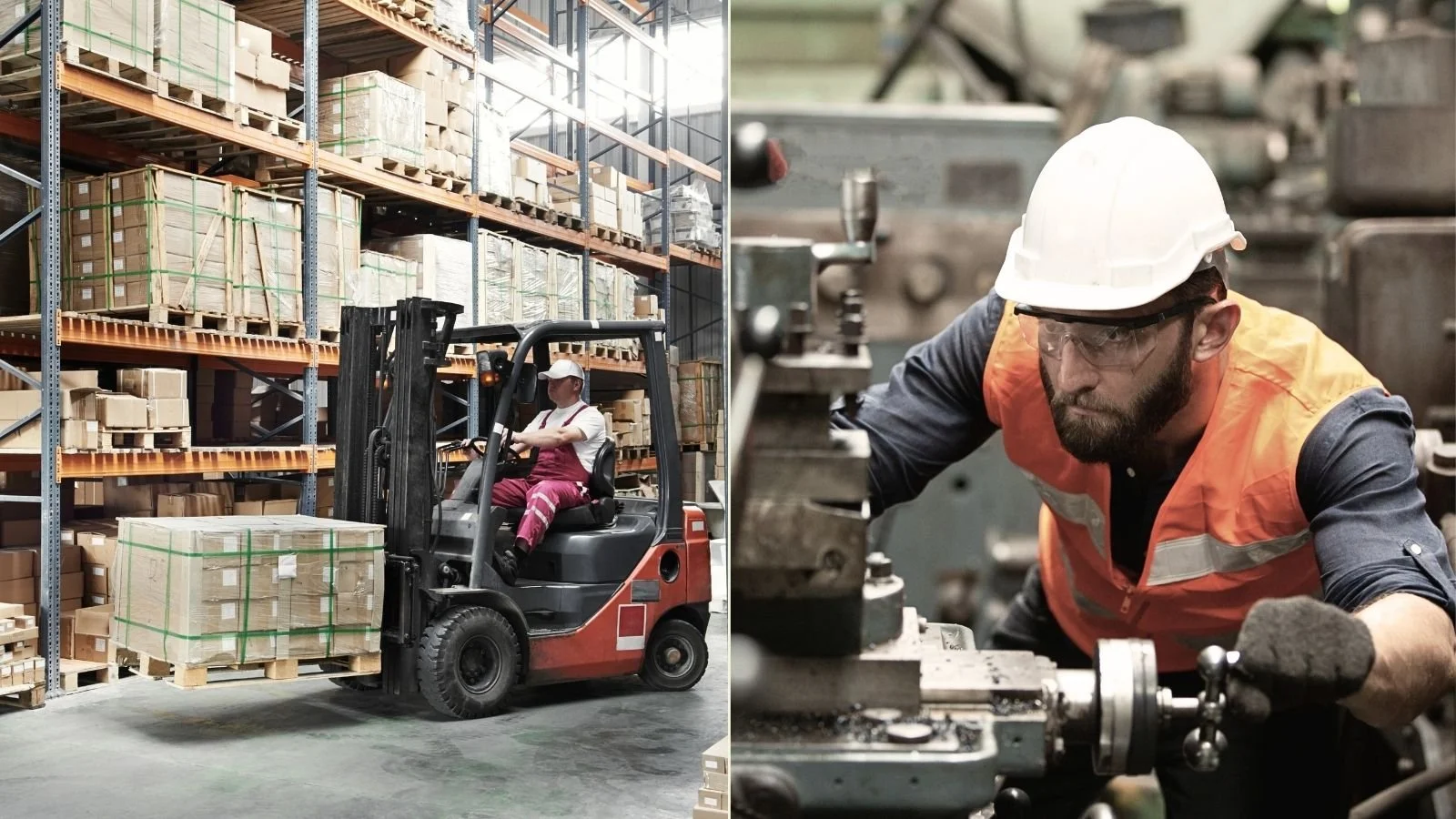
Left: goods stored under Customs Warehousing. Right: goods processed under Inward Processing Relief.
KEY TAKEAWAY
Customs Warehousing suspends import duty and VAT on goods you store. Inward Processing Relief (IPR) suspends them on goods you process, manufacture or repair. Both remove the duty entirely on goods that are exported, and many businesses hold both authorisations and move goods between them.
When businesses discover that HMRC offers ways to suspend or remove import duty, two names come up most often: Customs Warehousing and Inward Processing Relief. Both require HMRC authorisation and both can save significant sums. They are designed for different supply chains, though, and choosing the wrong one is a common and costly mistake.
This guide compares the two: what each does, who each suits, what each demands in ongoing records, and how to decide which one, or both, fits your business.
The core difference in one sentence
Customs WarehousingSuspends duty on goods being stored.
Inward ProcessingSuspends duty on goods being worked on.
If your goods arrive and wait in a warehouse until they are sold or exported, that is customs warehousing. If they arrive, get manufactured or repaired, and then leave the UK, that is Inward Processing. What matters is what happens to the goods while they are here.
If goods come into the UK for a set purpose, such as an exhibition or a test, and leave unchanged, neither applies. That is Temporary Admission.
What is a customs warehouse?
A customs warehouse is an HMRC authorised facility where goods from outside the UK can be stored under customs control without paying import duty or VAT. There is no fixed time limit. The suspension ends when goods are:
Released into free circulation in the UK, when duty is paid
Exported outside the UK, when duty is never paid
Moved into another customs procedure, such as Inward Processing
Destroyed under HMRC supervision
Goods in a customs warehouse must stay essentially as they arrived. HMRC allows only "usual forms of handling", such as repacking, relabelling, sampling, sorting and cleaning. Manufacturing, assembly or other substantial processing is not permitted. For the full picture, read our guide to what a bonded warehouse is and how it works.
What is Inward Processing Relief?
Inward Processing Relief (IPR) lets businesses import goods specifically for processing, manufacture, repair or transformation, with import duty and VAT suspended. If the resulting goods are exported, the duty is never paid. If they are sold in the UK, duty becomes due on that share, calculated on either the imported goods or the finished product.
The defining feature is change. IPR exists for goods that are worked on while they are in the UK.
Side by side comparison
| Customs Warehousing | Inward Processing Relief | |
|---|---|---|
| Purpose | Storing goods with duty suspended | Processing, manufacturing or repairing goods with duty suspended |
| Can goods be processed? | No, only usual forms of handling such as repacking or sorting | Yes, that is the purpose of the procedure |
| Time limit | No fixed limit | The discharge period set in your authorisation |
| Duty if exported | Never charged | Never charged |
| Duty if sold in the UK | Full duty on release | Duty on that share, on the imported goods or the finished product |
| Who it suits | Importers, distributors, logistics operators | Manufacturers, processors, repairers |
| Ongoing records | A stock account showing goods in and out | Stock account, processing records and a Bill of Discharge, usually quarterly |
| Extra HMRC check | None | Economic conditions test |
| Can you hold both? | Yes, and goods can move from a customs warehouse into IPR | |
Worked examples
Example 1: the importer that should use a customs warehouse
A clothing retailer imports £2 million of garments from Bangladesh and Vietnam each year. It sells around 70% in the UK and 30% to European wholesale customers, and holds stock for one to three months before dispatch.
This is a textbook customs warehouse case. The goods are only stored, so IPR does not apply. Duty on the 30% sent to Europe is never paid, and duty on the 70% sold in the UK is only paid when each order leaves the warehouse, which helps cash flow.
Example 2: the manufacturer that should use Inward Processing
A North West engineering firm imports steel components from South Korea, fabricates them into finished parts and exports around 80% of its output to the US, UAE and EU. The rest is sold in the UK.
This is a clear IPR case. The components are transformed before they leave. For a firm paying £200,000 a year in import duty, removing duty on the 80% exported saves £160,000 a year on the same production.
Example 3: the business that should use both
A pharmaceutical business imports active ingredients from India. Some are sold on to UK manufacturers, some are processed in house into finished products and exported, and some are held until a buyer is confirmed.
Stock awaiting a destination sits in a customs warehouse. Material going into its own production moves into IPR. Moving goods from the warehouse into IPR when processing is confirmed means duty is never paid on anything that leaves the UK.
For a real IPR result, see how we removed £37,000 a year in duty for a UK pharmaceutical manufacturer.
What about duty drawback?
Drawback means paying duty at import and claiming it back after the goods are exported. The UK has no general duty drawback scheme, so if you process goods for export, Inward Processing is how you avoid the duty. It is suspended at import instead of being paid and reclaimed.
Where Freeports fit in
If your site sits inside a Freeport customs site, the Freeport procedure can cover both storage and processing with duty suspended under a single approval. For some businesses this replaces separate warehousing and IPR authorisations. Read more about Freeports.
Which is more complex to apply for?
Both require HMRC authorisation and an assessment of your record keeping and financial standing. Inward Processing adds one step that warehousing does not have: the economic conditions test, which checks that the relief will not harm UK producers of similar goods. In practice most applications pass it without difficulty.
The ongoing work is also heavier for IPR. As well as a stock account, you keep processing records, set rates of yield and submit a Bill of Discharge for each discharge period. For complex manufacturing with many inputs and outputs, this takes real discipline. Our step by step guides to applying for Inward Processing Relief and setting up a bonded warehouse cover what HMRC checks at each stage.
The cost of getting it wrong
Using a customs warehouse to store goods you actually process risks revocation and a customs debt on everything processed under the wrong procedure
A manufacturer paying full duty when IPR would remove most of it is losing money every month, and may not be able to recover it retrospectively
A business that applies for IPR without robust processing records may fail HMRC's assessment or have the authorisation suspended after a compliance visit
OUR RECOMMENDATION
If your supply chain involves any processing, manufacturing or repair of imported goods, however minor, start with an IPR eligibility check before defaulting to a customs warehouse. The duty savings under IPR are often larger, and the two can always be used together.
Not sure which applies to you? Our free supply chain mapping session shows which duty reliefs are open to your business and what each could save.
Book a free consultationFrequently asked questions
What is the difference between customs warehousing and inward processing?
Customs warehousing suspends duty on goods you store without changing them. Inward processing suspends duty on goods you process, manufacture or repair. Both remove the duty on goods that are exported.
Can I use customs warehousing and inward processing together?
Yes. Many businesses hold both, storing goods in a customs warehouse until a destination is confirmed and moving them into Inward Processing when they are needed for production.
Do customs warehouses need a Bill of Discharge?
No. A customs warehouse keeps a stock account showing goods in and out. The Bill of Discharge is an Inward Processing requirement, usually filed quarterly.
Is Inward Processing the same as duty drawback?
No. Drawback means paying duty and claiming it back after export. The UK has no general duty drawback scheme, so Inward Processing is how businesses avoid duty on goods they process and export.